
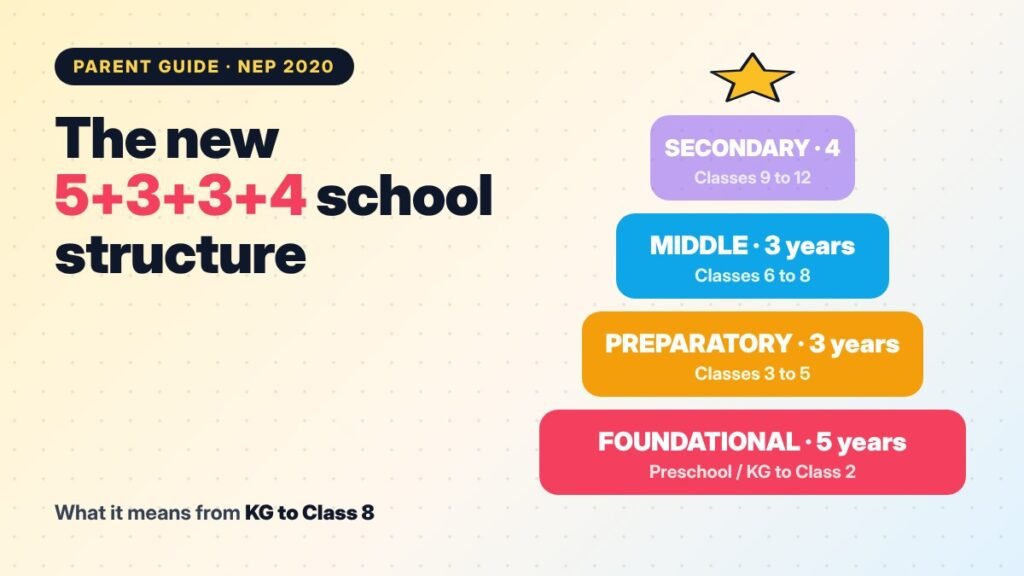
If you went to school in India, you grew up with the 10+2 system. The National Education Policy 2020 (NEP 2020) replaces it with a 5+3+3+4 structure that groups classes by how children actually learn at each age. For parents of children from KG to Class 8, three of the four stages matter right now.
The four stages at a glance
- Foundational Stage (5 years): three years of preschool or kindergarten plus Classes 1 and 2, roughly ages 3 to 8.
- Preparatory Stage (3 years): Classes 3 to 5, roughly ages 8 to 11.
- Middle Stage (3 years): Classes 6 to 8, roughly ages 11 to 14.
- Secondary Stage (4 years): Classes 9 to 12, roughly ages 14 to 18.
Foundational Stage: KG to Class 2
The policy treats the preschool years as part of school education, not as a waiting room before Class 1. Learning at this stage is meant to be play-based and activity-based: stories, rhymes, games, drawing, counting with real objects and plenty of talking. Heavy textbooks and formal written exams are not the goal here. The aim is that every child learns to read with understanding and handle basic numbers.
The policy also expects a child to be about six years old when entering Class 1, so it helps to check the age rule your school follows before planning admission.
Preparatory Stage: Classes 3 to 5
Children now move gradually from play-based learning to more structured classroom lessons, with textbooks in language, mathematics and environmental studies. The method still relies on activities and discovery, but reading, writing and speaking become more formal. This stage builds the base on which every later subject depends.
Middle Stage: Classes 6 to 8
In the Middle Stage children meet subject teachers for science, mathematics, social science, languages and arts. The focus shifts to understanding concepts and learning through experiments and discussion rather than memorising answers. NEP 2020 also recommends exposure to vocational skills and coding from Class 6, along with a period of bagless days during these years for hands-on activities.
Language of teaching
The policy recommends that, wherever possible, the medium of instruction until at least Class 5 should be the home language or mother tongue, while children also learn other languages, including English. Schools apply this in different ways, so ask your school how it balances Hindi, English and other languages in each class.
What parents can do
- In the early years, value play, stories and conversation as real learning.
- Ask the school which stage your child is in and what the learning goals are for that stage.
- Look at understanding, not only marks: can your child explain an idea in their own words?
- Encourage reading for pleasure in both Hindi and English.
Rules on admission age, languages and exams are implemented by each state and board. For details that apply to your child, please confirm with the school office.